"courseNameEdt.text" is the answer. The reason that it crashes is because the view with id "idEdtCourseName" is either inaccessible on that screen or is not an EditText. Use ViewBinding.
Did you find a proper solution for this by any chance?
Unfortunately this still appears to be a problem with Swift Log, and is tracked as an active issue on the official GitHub repo.
I ran into the same problem running Ubuntu 24.04 while trying to install Swift 6.0.1. I ended up downgrading my target instance to Ubuntu 22 to compile successfully.
If the row height is fixed, you can calculate the number of pages in advance because you will know how many rows will be on each page.
The pyo3_runtime.PanicException inherits from Python's BaseException, so using BaseException in the try:except block successfully catches the panic. It's quite a broad sweep but will do in a pinch.
See another SO q&a here
See the pyo3 docs here
what missing host permission was needed?
I had an error in the js file, specifically: Office.actions.associate wasn't completed properly.
From my experience, a Glue job sometimes gets stuck instead of terminating gracefully after an exception is thrown. I suspect that your Glue service role is missing the required permissions to start the crawler. When you run it in your python console you might use a different role, which would explain your observation.
In order to verify that, print the response of the start_crawler request and wrap the call in a try/except block so that you can print the error and shut down the job.
I ended up just creating a feature with the environment variables that wrenv.exe creates and attaching that to my tooolchain.
I have tried in mysql based on sample data and expected output, syntax should be very similar to Terradata.
SELECT
c.customer_number,
c.ninnbr,
COUNT(*) OVER (PARTITION BY c.ninnbr) AS unique_count
FROM
customers c
ORDER BY
c.ninnbr, c.customer_number;
Output
Strange - I got exactly the same error, but for me, specifying "AZURE_TENANT_ID" or the connection-specific "<CONNECTION_NAME_PREFIX>__tenantId" in local.settings.json worked:
{
"IsEncrypted": false,
"Values": {
"<CONNECTION_NAME_PREFIX>__fullyQualifiedNamespace": "<NAMESPACE>.servicebus.windows.net",
"<CONNECTION_NAME_PREFIX>__tenantId": "<tenantId>" // This line fixed the error for me
}
}
Using connection-specific settings as opposed to "AZURE_*" is described here: https://learn.microsoft.com/en-us/azure/azure-functions/functions-reference?tabs=blob&pivots=programming-language-csharp#azure-sdk-environment-variables
This is not a Answer but my hands for my rig are moving at the same time
Mine had power save mode on, I turned it off in notifications
Not that I think this will actually help... I think this more just demonstrates how generic the exception is, that so many 'solutions' are possible to fix one generic error message.
But, lessons learned for me: None of the troubleshooting and issues mentioned by commenters here helped me. GPT was no help. Well, sort of...it did mention my issue in passing. Temp Tables.
I have an edge case: I have an app that must build "payloads" of transactional data and pass them up through an MQTT broker. Queries must run every minute to build more payloads, and they must reach out to other databases for much of this through linked servers.
So, performance is a must. I can't have a very costly join to large production tables hinder me. So, I designed my app to replace any huge tables with joins to temp tables (which I build up with only the records needed), making the joins astronomically cheaper.
This caused a new problem: I'm using tempdb too much. Too many temp tables are being created, filled, queried, and dropped in rapid succession.
It took me 14 solid hours of research and troubleshooting... multiple iterations of recreating the database from script, repopulating data, testing, hitting the "kill state," swearing a bit, revising my create database script, rinse and repeat.
The real problem for me is both temp tables and linked servers have been known to cause this issue... along with corrupt indexes... and who knows what else. So I had no clue what could be causing this. I had to poke at everything.
So, here's what I did to fix it:
Made sure DB compatibility was then set to 160 (SQL Server 2022.)
ALTER DATABASE [database_name] SET COMPATIBILITY_LEVEL = 160;
Added more database MDF files to tempdb - 1 per core, making those files bigger than default with better ability to grow. This reduces resource contention as every core can now hit tempdb without stepping on each other
ALTER DATABASE [tempdb] ADD FILE (NAME = N'tempdev2', FILENAME = N'C:\TempDB\tempdb_mssql_2.mdf', SIZE = 1024MB, FILEGROWTH = 256MB);
ALTER DATABASE [tempdb] ADD FILE (NAME = N'tempdev3', FILENAME = N'C:\TempDB\tempdb_mssql_3.mdf', SIZE = 1024MB, FILEGROWTH = 256MB);
ALTER DATABASE [tempdb] ADD FILE (NAME = N'tempdev4', FILENAME = N'C:\TempDB\tempdb_mssql_4.mdf', SIZE = 1024MB, FILEGROWTH = 256MB);
Made those files all the same size.
ALTER DATABASE [tempdb] MODIFY FILE (NAME = N'tempdev', SIZE = 1024MB);
ALTER DATABASE [tempdb] MODIFY FILE (NAME = N'tempdev2', SIZE = 1024MB);
ALTER DATABASE [tempdb] MODIFY FILE (NAME = N'tempdev3', SIZE = 1024MB);
ALTER DATABASE [tempdb] MODIFY FILE (NAME = N'tempdev4', SIZE = 1024MB);
Turned on memory-optimized tables (introduced in SQL Server 2017).
ALTER SERVER CONFIGURATION SET MEMORY_OPTIMIZED TEMPDB_METADATA = ON;
-- Restart the SQL Server instance for the change to take effect
Created a maintenance job to run in a maintenance window to drop any temp tables older than 1 day.
Placed a 1-second timer between the CREATE TABLE statement and the INSERT to handle any potential delay (GPT said there could be, I have no proof it's asynchronous, but it seemed to help.)
WAITFOR DELAY '00:00:01'; -- Wait for 1 second
I already designed my app to drop temp tables when finished, but that's important here too. Don't abandon temp tables, drop them when your script is finished.
why not just use a loop to print it like so:
x=str(RandMAC())
for i in range(3):
print(x)
This solution uses the formula of the questioner Statto of this discussion: Restarting and resuming a running total for multiple values
One formula for scenarios with and without blanks:
=SUM(N(MAP(A2:A11,LAMBDA(a,COUNTIFS(INDEX(A2:A11,1):a,a)))>1))
=SUM(N(MAP(B2:B14,LAMBDA(a,COUNTIFS(INDEX(B2:B14,1):a,a)))>1))
changed it to this one line:
html = ActionController::Base.render(template: 'invoices/pdfs/show', layout: false, locals: { ticket_images: ticket_images })
As far as I understand, the centering of your logo is done through
position: absolute, and to prevent your logo from overlapping with other blocks, add an Intro component position: relative.
You have a function call in m.bind('<FocusOut>', reset(m)). Remove it.
same here... the .pkg file installed. the application is correctly found in launchpad and in /applications/ but when clicked seemingly nothing happens although I think I see the icon pop and then close in an instant on the dock.
I used jsdom instead of domparser, it works
What I ended up doing is to override OnKeyDown and OnKeyUp methods on the main windows of the Avalonia app, and then I am mapping Avalonia.Input.Key enum to SDL.SDL_Keycode enum. After that I am creating a new SDL2 event with a given key down/up like so:
public void OnKeyUp(SDL.SDL_Keycode key)
{
SDL.SDL_Event _event = new SDL.SDL_Event();
_event.key.keysym.sym = key;
_event.type = SDL.SDL_EventType.SDL_KEYUP;
SDL.SDL_PushEvent(ref _event);
}
public void OnKeyDown(SDL.SDL_Keycode key)
{
SDL.SDL_Event _event = new SDL.SDL_Event();
_event.type = SDL.SDL_EventType.SDL_KEYDOWN;
_event.key.keysym.sym = key;
SDL.SDL_PushEvent(ref _event);
}
Thanks to that I am able to get all key up/down events from the Avalonia into the SDL2 app.
Alright. I have done it.
@echo off
setlocal enabledelayedexpansion
rem Loop through existing .xhtml files in reverse order
for /L %%i in (478, -1, 0) do (
if exist %%i.xhtml (
set /a newnum=%%i + 1
rem Attempt to rename the file
ren %%i.xhtml !newnum!.xhtml
)
)
endlocal
Make sure to indicate the highest number name in the code. My was 478.
The generated SQL command is missing the colon after the WITH keyword, try it
Are you required to use Google Earth? I use Google Maps to render a couple thousand points over USA and we use a feature that, depending on the zoom level, it groups those points into markers, and as you zoom in, it will unpack those markers into individual points again.
I am not familiar with Google Earth API so I am not sure if the same is available, but usually when working with that kinda of representation you might want to create a logic or use a feature that will remove the unique points and turn them into a marker, or shape as you mention.
You also have huge benefits for only displaying points that are in an area visible for on the screen. That is also something we do on my implementation of Google Maps. My points are over USA, so if I zoom in Texas, I remove from the GMaps points array any location outside of that zoom area.
For that you will use Gmaps getbounds to be able to get the current visible area and then calculate if your points lat/long are within that area. If you google or look up here in Stackoverflow you will see a couple different ways to implement that.
Also for visualization, you might check other solutions, like Mapbox and OpenStreetMaps. But again, they are nothing like Google Earth.
Just for note: I was added python-celery package to MSYS2. And eventlet pool can be used too.
мне тут помогли со взломом как и обещал оставляю отзыв сделали все в короткие сроки.качественно человек даже не узнал об этом ставлю твердую 5+++ спасибо большое кому нужно вот номер телефона +79033500820 почта [email protected] спасибо дмитрию
I have the error message below (env) C:\xampp\htdocs\imgdwn\radardeprix_test\python-test\lib>pip install fasttext-0.9.2-cp311-cp311-win_amd64.whl ERROR: fasttext-0.9.2-cp311-cp311-win_amd64.whl is not a supported wheel on this platform.
Can you help please
Are you using a Coroutine? If so, this is not a matter of the wrong JPEG etc. I'm experiencing the same thing. Sometimes it works, and sometimes it doesn't. It's almost as if one thread is updating the image while another is accessing it.
patchelf 0.18.0 supports to print, clear and set executable stack state on binary.
"--print-execstack" Prints the state of the executable flag of the GNU_STACK program header, if present.
"--clear-execstack" Clears the executable flag of the GNU_STACK program header, or adds a new header.
"--set-execstack" Sets the executable flag of the GNU_STACK program header, or adds a new header.
If the error is for the txn, you might be reading all files recursively because databricks delta parquet creates a folder with logs and such, within this folder there are additional tables with more columns.
If so, remove the recursively option from the source of the copy data activity:
I have a clue) Their zebra-colorized table is messing with your eyes) All the 3 colors are the same, just the middle one gets darker because of the table beneath.
You can check that with DevTools.
Note how on this pic all the 3 colors are now the same, as I disable table's background.
You are probably reading all files recursively because databricks delta parquet creates a folder with logs and such, within this folder there are additional tables with more columns, hence the txn.
So, remove the recursively option from the source of the copy data activity:
Turns out Unity has changed how global textures are handled with the new version. Please refer to this answer I've got from the Unity staff.
In the end I found a much simpler solution than writing my own rendering feature.
I found out that the camera depth texture is available in the OnRenderObject call. So I'm just fetching it there and doing my logic etc. in Update.
Just make sure to add a null check before you start rendering.
Previously in 2021 and prior I also had to wait 1 frame until the depth texture was generated but this was still possible using only the Update loop.
For anyone who might need it, 'zoom' in X.canvas.toolbar.mode worked for me.
While using NestJS with VSCode, Is there a better way to separate the application logs in a new tab or use log filters within same console?
I was able to get this to work but is seems a little clunky and not as elegant as I was hoping for.
df3 = (pl.DataFrame(data)
.with_columns(
diff = pl.col('strike') - pl.col('target'))
.with_columns(
max_lt_zero = pl.when(pl.col('diff') < 0).then(pl.col('diff')).otherwise(None).max(),
min_gt_zero = pl.when(pl.col('diff') > 0).then(pl.col('diff')).otherwise(None).min())
.filter(
pl.max_horizontal (
pl.col('diff') == pl.col('max_lt_zero'),
pl.col('diff') == pl.col('min_gt_zero')))
.select(['strike', 'target', 'diff'])
)
shape: (2, 3)
┌────────┬────────┬──────┐
│ strike ┆ target ┆ diff │
│ --- ┆ --- ┆ --- │
│ i64 ┆ i64 ┆ i64 │
╞════════╪════════╪══════╡
│ 15 ┆ 16 ┆ -1 │
│ 20 ┆ 16 ┆ 4 │
└────────┴────────┴──────┘
You can use chatgpt, if you ask it he will turn it into raw bytes (i had the same problem).
I like to use the URL API in such cases
const url = new URL('http://myapi.com/orders');
url.searchParams.append('sort', 'date');
url.searchParams.append('order', 'desc');
fetch(url.href);
This code work fine for me:
mysql> update link_productgroepen set groep_id=(select groep_id from link_productgroepen_bck where link_productgroepen.sku=link_productgroepen_bck.sku);
link_productgroepen_bck contains a backup of the table link_productgroepen ,so the structure is the same. In order to update the link_productgroepen table I need to drop it and to create a new empty clone of it that gets filled with the new values provided by an other website by an api. This new dataset needs to be complemented by information present in 2 columns in the link_productgroepen_bck table. The code above copies the contents of the groep_id column in the link_productgroepen_bck table to the renewed ink_productgroepen table if the sku value in both tables is the same. The other backupped column is copied by the same mysql command but with the other column name.
You should use GREATEST/LEAST, this function returns NULL if at least one value is NULL.
So this code:
select * from TABLE where LEAST(COLUMN_1, COLUMN_2, COLUMN_3, COLUMN_4) is not null
will only return results if all columns are non-null.
We dont have the example data for tables like cs_facilities, cs_fundingMethods, ci_periodicBillings etc.
I created this example based on the sample data you provided and the expectation that you shared.
WITH RateChanges AS (
SELECT
Client,
Rate,
Funding,
LastUpdated,
LAG(Rate) OVER (PARTITION BY Client ORDER BY LastUpdated DESC) AS PreviousRate,
LAG(Funding) OVER (PARTITION BY Client ORDER BY LastUpdated DESC) AS PreviousFunding
FROM ClientBillingInfo
WHERE LastUpdated BETWEEN '2024-09-01' AND '2024-09-30' -- Filtering only September 2024
)
SELECT
Client,
Rate AS LatestRate,
PreviousRate,
Funding AS LatestFunding,
PreviousFunding,
LastUpdated
FROM RateChanges
WHERE PreviousRate IS NOT NULL -- Ensures that there's a previous rate (indicating a change)
ORDER BY Client, LastUpdated DESC;
Output :
I think u should start use parallel programming like MPI library
As of torchvision version 0.13, the class labels are accessible from the weights class for each pretrained model (as in the documentation):
from torchvision.models import ResNet50_Weights
weights = ResNet50_Weights.DEFAULT
category_name = weights.meta["categories"][class_id]
My workaround was to go to Resource > Manage added data sources > Edit
I added a new dimension called 'Exclusions'
I used a Case statement in this to set the field value to 'Exclude' for items I wished to exclude, and 'Include' for items I wanted to include.
I then set the Exclusions field in the drop down list, and set the default value to 'Include'
Instructions for the case statement: https://support.google.com/looker-studio/answer/7020724?hl=en#zippy=%2Cin-this-article
I checked the Jira Administration section on a sample account and there isn't a stock Requirements field which makes me think it is a custom field in your cloud installation (unless your are using a server installation).
Can you clarify if you are using cloud or server impleentation? I can't tell from the url you specified if it is a hosted jira server implementation or a custom url for a cloud implementation.
If it is a cloud implementation, can you make a python rest api GET call to the following JIRA REST V3 API named field
https://sample_company.atlassian.net/rest/api/3/field
Make sure to update the url with your cloud instance or it will fail as sample_company isn't a real domain.
That will return all the fields whether they are system or custom in json format. You can then parse the json to find the field(s) once you know the field names. Here is the structure of a sample field from a sample jira cloud installation for reference
{
"id": "customfield_10072",
"key": "customfield_10072",
"name": "samplefield",
"custom": false,
"orderable": true,
"navigable": true,
"searchable": true,
"clauseNames": [
"cf[10072]"
],
"schema": {
"type": "string",
"system": "samplefield"
},
"customId":10072
},
The name will most likely be Requirements for the custom field you are lookiing for since that is what is rendering in the screenshot but id and key for the field will have a name such as customfield_NNNNN where the NNNNN is a custom number depending on how many custom fields you have in your installation. Once you know this id or key, you can make a python rest api call to the JIRA REST V3 API for your issue and get the custom field values from the previous API. This will change from customer install to customer install so I can't give the exact field.
Here is the Jira Rest API for an issue for example:
https://sample_company.atlassian.net/rest/api/3/issue/jira_ticket
where jira_ticket is the name of the jira_ticket you are trying to get the data from.
So for example if my ticket is XX-13515, I would make a GET Request to
https://sample_company.atlassian.net/rest/api/3/issue/XX-13515
That would return JSON output. You could then parse the results for the customfield_NNNN for your Requirements field and the other field you are looking for. There could be multiple ways you would find the field in the results for your issue such as:
{
"id": "customfield_10027",
"key": "customfield_10027",
"name": "Requirements",
"untranslatedName": "Requirements",
"custom": true,
"orderable": true,
"navigable": true,
"searchable": true,
"clauseNames": [
"cf[10027]",
"Requirements",
"Requirements[Paragraph]"
],
"schema": {
"type": "string",
"custom": "com.atlassian.jira.plugin.system.customfieldtypes:textarea",
"customId": 10027
}
},
or it could be a simple url such as
"customfield_10072": null,
or possibly some other type. So anything would else be speculation at this point without some sample results from you to investigate further.
I haven't tried it yet, but it looks like there is a set of helper classes and extension methods for 2d spans and memory.
This has been fixed in PDFBOX-5908 and will be in PDFBox 3.0.4. A snapshot build is available here, please test it just to be sure. Thank you for reporting this.
You can use Python’s dataclasses module alongside libraries like pydantic or dataclasses-json to map JSON to nested Python classes automatically.
class ValidList(BaseModel): data: List[List[str]]
@validator('data', each_item=True)
def check_sublist_length(cls, sublist):
if len(sublist) < 2:
raise ValueError(f"Sublist {sublist} must have at least 2 elements.")
return sublist
Optional is usually not recommended for ConfigurationProperties. This is a known behaviour which spring-boot marked as 'not a bug, but a feature'.
Source : https://github.com/spring-projects/spring-boot/issues/21868
Checkout these comments specifically :
f(x,y)=6xy
f'x=6y
f'y=6x
f'x'x=0
f'x'y=6
f'y'x=6
f'y'y=0
I had recently encounter with the same error in my old project after researching i got the Solution and Created blog on this to solve error
For anyone coming here late, slight correction/clarification to @cb-bailey's answer:
A file in the index, which is equivalent to "staging area", is considered tracked locally.
If a file has been added to the index using git add, i.e. it is marked as tracked, and you do not commit it but use git rm --cached, then it is not a no-op, since it will still remove the file from the index, so that the file ends up being untracked again. The file still exists in your working tree and can be re-added.
On the other hand, git reset is used to, well, reset a file or directory to the current branch's HEAD or a specified commit in your index, while a dedicated mode argument defines what effect will take place on your local working tree.
Some times we need to check if the PVC is full , since pods are not starting for porblme determination :( can not use df
There is an article on this in case someone across it now. medium link
This answer is years late, but you may wish to explore pagedtable.js which is a javascript table library allowing paging of both rows and columns. It's the same implementation that is used for the inline paged dataframe display in rmarkdown.
I do not believe it has the ability to "freeze" the first column like you are asking but it's pretty close.
Take a look at Transactional Outbox pattern from AWS Prescriptive Guidance https://docs.aws.amazon.com/prescriptive-guidance/latest/cloud-design-patterns/transactional-outbox.html
To guarantee that the delivery order of messages to Amazon SQS (or Kinesis) matches the actual order of database modifications, you can implement the Outbox Pattern. We considered this for one of our projects and thought this was an overkill, but this seems to solve the order issue
Response to TikTok Shop API Messaging Inquiry Hello,
As of my last update, the TikTok Shop API does provide some capabilities for messaging, particularly through webhooks that allow sellers to receive and send messages from buyers. However, the explicit support for messaging between sellers and creators is not clearly defined in the API documentation.
Here are some key points to consider:
Buyer to Seller Messaging:
The API supports webhook notifications for new messages from buyers. This allows sellers to automate responses and manage inquiries effectively. Seller to Creator Messaging:
While there is functionality for targeting collaborations and reaching out to creators, direct messaging capabilities specifically for seller-creator interactions may not be explicitly supported. It is advisable to check the latest version of the TikTok Shop API documentation, as features can evolve. Webhooks:
You mentioned webhook support, which is a good start for automating buyer interactions. If there are updates or changes regarding creator messaging, they may be announced through the API changelogs or updates. Recommendations:
I recommend reaching out to TikTok's developer support or checking their community forums for the most current information regarding messaging capabilities. Engaging with other developers who have experience with the TikTok Shop API may also provide insights into any undocumented features. If you have further questions or need assistance with specific API calls, feel free to ask!
Best regards.
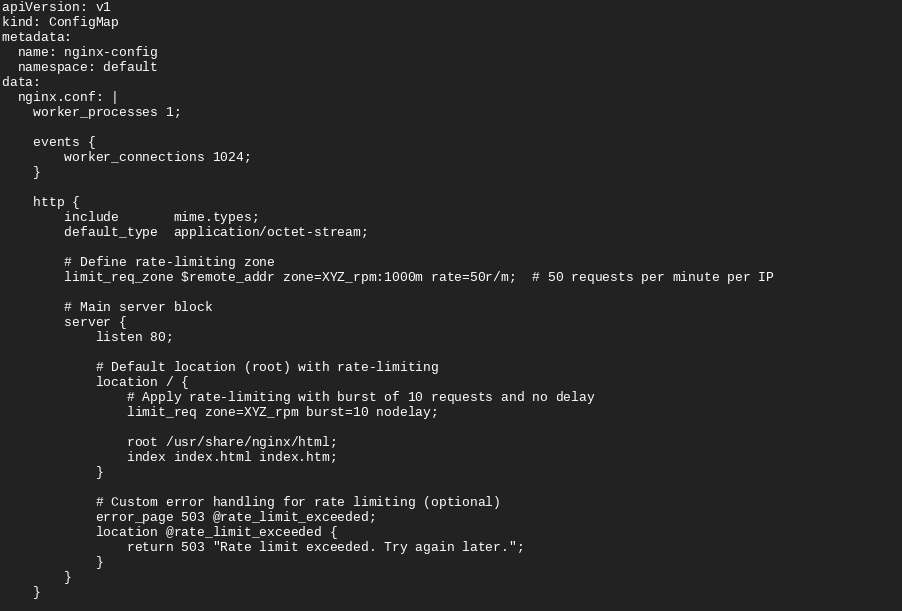
These annotations are only limited for connections and transmission rates, to set the size of the shared memory zone it must be configured through ConfigMap by changing the zone size directly zone=name:size make sure to use unit-m(megabyte). Please see sample configmap below:
Additionally, based on this blog the limit_req_zone directive sets the parameters for rate limiting and the shared memory zone, but it does not actually limit the request rate.
Using Xcode (e.g. version 16.1) and Gimp:
If no (default) asset catalog exists in the iOS project, create one with Xcode: File -> New -> File from Template... -> (Resource) Asset Catalog -> Next -> (Save as: Assets.xcassets) Create
Create a graphics file, e.g. AppIcon.png of (NB!) 1024 x 1024 pixels. Starting e.g. from an .svg file, open it in Gimp with the required dimensions, then export it as a .png. (A Google Playstore 512 x 512 .png file will not be accepted.)
In Xcode, select Assets.xassets (maybe the one created in the first step) in the Project Navigator. Then select AppIcon in the tab on the right, and double click on the block labelled 'Any Appearance'. Use the file picker that appears, to find and accept the file AppIcon.png created in the second step.
Launch the app from Xcode on a simulator or device with the 'Start the active scheme' arrow button. Wait for the debugger to attach to the target (done when the message at the top right says 'Running [app] on [target]'), then stop the app with the block button to the left of the arrow button.
Check on the simulator or device to ensure that the default iOS app icon has been replaced with the one created in the second step.
binding.scrollView.post {
binding.scrollView.smoothScrollTo(0, 0)
}
Browsers make some scss by their "own", so probably Chrome behaves different because it limits the height of your div, I made a quit view on the menu popover, and could change a bit Change1 Change2
you can put a min-width and max-height for the ul or divs that have the items, to make sure they have enough space, also could do some no overlap of the elements Example here
A great way to understand better flexbox is in this Web Flexbox Tricks Be carefull with the lists inside the lists (ul inside li and another ul)
Hope this helps
Can you show your full code? Are you saying you want the bottom navbar to exist with the tab bar to control the pages of the same screen?
I'm facing the same error for two days. Does anyone have a solution??
import pandas as pd
month_list = ["Jan", "Feb", "Mar", "Apr", "May", "Jun", "Jul", "Aug", "Sep", "Oct", "Nov", "Dec"] months = { 'Jan': 0, 'Feb': 1, 'Mar': 2, 'Apr': 3, 'May': 4, 'Jun': 5, 'Jul': 6, 'Aug': 7, 'Sep': 8, 'Oct': 9, 'Nov': 10, 'Dec': 11, } data = [['Sep', '2024', 112], ['Dec', '2022', 79], ['Apr', '2023', 114], ['Aug', '2024', 194], ['May', '2022', 140], ['Jan', '2023', 222]]
sorted_data = sorted(data, key=lambda x: (int(x[1]), months[x[0]]))
print(sorted_data)
The code sorts the data list first by year (ascending) and then by the month's order using the months dictionary.
I did a research and JEvents has a plugin called User Specific events, available as an option to silver members (paid subscription). I'm seriously thinking to use it because free JEvents is such a powerful tool, but I need something individual for each user.
Check it out: https://www.jevents.net/join-club-jevents?view=article&id=304
Could you please try following command and see if it is connecting or not?
mysql -h your_remote_host -u your_user -p
telnet your_remote_host 3306
Above command will help you to verify the connection from your machine.
Could you please paste error as well? that will help with getting more details on issue.
anyway to make permanent even for new created users? tried to use and customize the NTUSER.DAT but without luck
I am attempting to add ATtiny in the boards manager. I've tried adding both:
https://github.com/SpenceKonde/ATTinyCore.git
https://drazzy.com/package_drazzy.com_index.json
to the additional boards manager in settings, but then when I go to search for them in boards manager nothing shows up. Do I need to wait until I have the Atiny phyiscally plugged in? Or are these just out of date? I'm using IDE 2.2.1. Thanks!
EDIT: It worked! I followed this tutorial: https://www.instructables.com/How-to-Program-an-Attiny85-From-an-Arduino-Uno/\
Same Problem. I have a simple function in a module:
NumberOfFoldersInDir($pathToDir, $_isRecursive)
This module is used by a class within another module. I return a value, depending on the optional bool param _isRecursive:
if($_isRecursive) { return (1) }; else { return (2) }
1) (Get-ChildItem -Path $pathToDir -Directory -Recurse).Count
2) (Get-ChildItem -Path $path -Directory).Count
In the module, when I save to a variable and write-host, values are:
1) == 2
2) == 1
In my class, in the other module:
1) $returnVal = NumberOfFoldersInDir $path $true == 2 Checks Out.
2) $returnValue = NumberOfFoldersInDir $path $false == 3 WTF?
The code provided here -
const instance = axios.create({
baseURL: process.env.URL,
headers : {
'Authorization': `Bearer ${token}`
}
})
will run only once You need to use interceptors to retrieve and pass the token for each network request. Reference: https://axios-http.com/docs/interceptors
I’m facing the same issue and currently working on fixing it. If you have any suggestions or solutions, I'd greatly appreciate it if you could share them with me. Thank you!
Strict Mode Docs: https://react.dev/reference/react/StrictMode
import { createRoot } from "react-dom/client";
import App from "./App.tsx";
import "./index.css";
// Remove strict mode
// With strict mode, the 1st time the useEffect is called,
// it will be called a 2nd time
// createRoot(document.getElementById('root')!).render(
// <StrictMode>
// <App />
// </StrictMode>,
// )
createRoot(document.getElementById("root")!).render(<App />);
Open CMD as administrator Run: assoc .js=NodeJSFile ftype NodeJSFile="C:\Program Files\nodejs\node.exe" "%1" %*
and verify file association by assoc.js it should show that .js file is associated to node.js
This worked, although the url in the browser returns a 404.
bazel build //example:hello-world --registry=http://my.gitlab/my_group/bazel-central-registry/raw/dev
Scanner sc=new Scanner(System.in); As,Scanner class-It belong to java.util package where it is used for user input. sc=new Scanner(System.in)-It is an object creation statement.As,it is used to create an new object in the scanner class where the variable named is sc. (System.in)-As, it an standard input stream,means keyborad when the program is executing. Hope it will be helpful for you.
When you attempt to read from the pipe within a PySpark UDF, you encounter the [Errno 9] Bad file descriptor error. This occurs because the file descriptor created using os.pipe() in the main Python process is not accessible within the UDF.
Spark executors are separate processes on worker nodes. When you create a UDF, the Python code is executed within a new Python process spawned by the Spark executor. File descriptors are not inherited by child processes. This means the file descriptor created in the main process does not exist in the UDF's process.
I did it this way: /Command
yarn create expo-app client --template blank
Remembering that I put client because that's the name I always use, but you can call it whatever you want, just change the name.
Is this still an issue? I tried every example from above and nothing works, to set fullscreen to a different size than desktop.
Tried 1280x800, desktop is 1920x1080.
Best result is auto, where everything is in correct ratio but at 1920x1080. In fullscreen True the ratio is weird, seems like 1920x800.
The issue is the bot blocking that they have employed.
See this text:
<h2 data-translate="blocked_resolve_headline">What can I do to resolve this?</h2>
<p data-translate="blocked_resolve_detail">You can email the site owner to let them know you were blocked. Please include what you were doing when this page came up and the Cloudflare Ray ID found at the bottom of this page.</p>
This isn't my field of expertise, but for other tasks similar to this, I have used the API instead.
This seems to be their API information: https://docs.drugbank.com/v1/
API signup looks like it should be here. https://dev.drugbank.com/clients/sign_in
Alternatively, if you don't need access in that way - you could save down the file to local, and load it from there.
What I think you are looking for is something like this: DefaultValue To set the default value of the ENUM. Hope this helps
For my case, the reason is the sbt.version in project build.properties file is too old; after updated to the latest one, it works.
You can manage the state in React JS by using the React's state management features or integrating with a state management library: React's state management features: Use the useState and useEffect hooks to manage the local state within a page. State management libraries: Integrate with a state management library like: Avoid using a global store. Since App Router can handle multiple requests simultaneously, using a global store could lead to data being handled from two different requests simultaneously.
if (tea < 5 || candy < 5)
return 0;
if ((tea >= 2 * candy) || (candy >= 2 * tea))
return 2;
else
return 1;
I'm facing the same issue and as a workaround am adding include_directories(${<lib>_INCLUDE_DIRS}) as each target exports this variable . It does the trick but I do not understand the root cause so would be interested to follow this thread
Why don't you validate the params inside? like:
@ResponseStatus(HttpStatus.OK)
@GetMapping()
public void foo(@RequestParam(value = "someValue1", required = false) String someValue1,
@RequestParam(value = "someValue2", required = false) final String someValue2) {
// Do validation here
if (someValue1 == null && someValue2 == null) {
throw new BadRequestException("someValue1 or someValue2 has to be present");
}
if (someValue1 != null) {
// use someValue1
}
if (someValue2 != null) {
// use someValue2
}
}
Spring doesn't have an build in feature for that case, at least i don't know it
Harvard CS50 Half Program: float half(float bill, float tax, float tip) function cap
I know this is an old topic... IF I want to restrict to accounts only in my B2C directory only (single tenant), how do I configure MSAL to support this?
I don't want to support/allow other directories or social logins.
I came across this post among others 2 years ago, while searching for the same thing.
This is now supported by AWS (UDP over IPv6 on NLBs) and was mentioned in this release - https://aws.amazon.com/about-aws/whats-new/2024/10/aws-udp-privatelink-dual-stack-network-load-balancers/
I was really excited as we've been waiting for this for 2 years but unfortunately, it requires SNAT and alters the client source IP - which might be ok for others, but is useless for us.
I hope that AWS can expand on this and have the ability to preserve the client IP, then it's an option. Shame this wasn't part of the solution since many other LBs have this functionality.
For my concrete problem, I could solve the issue by "just switching" to esbuild:
- "executor": "@angular-devkit/build-angular:browser",
+ "executor": "@nx/angular:browser-esbuild",
While I don't understand the underlying issue completely, I am fine with "the fix".
Será tarde para opinar? ya pasaron casi 10 años de está pregunta, acabo de tener precisamente esté problema y se resuelve teniendo la conexión abierta, fácil como un bucle, pero hay que precisar que esto sería para ser usado más como un socket que como una petición al servidor:
@WebServlet("/events")
public class SSEServlet extends HttpServlet {
@Override
protected void doGet(HttpServletRequest req, HttpServletResponse resp) throws IOException {
System.out.println("1");
resp.setContentType("text/event-stream");
resp.setCharacterEncoding("UTF-8");
resp.setHeader("Cache-Control", "no-store");
resp.setHeader("Connection", "keep-alive");
resp.setStatus(HttpServletResponse.SC_OK);
while(true) {
PrintWriter writer = resp.getWriter();
writer.write("data: Evento disparado desde SSE\n\n");
writer.checkError();
writer.flush();
try {
Thread.sleep(2000);
} catch (InterruptedException ex) {
Logger.getLogger(SSEServlet.class.getName()).log(Level.SEVERE, null, ex);
}
}
}
}
There's a Chrome extension on Github called "Liquify". It modifies the search at the top of the liquid file list to search inside the files. Unfortunately, it now has a bug whereby, although the search box still works fine, you can't see what you typed in! So I copy and paste into it now.
I have the same same question here, and there doesn't seem to be an answer online.
Note that in 2024 this methodology changed. The new format, currently very poorly documented, is as follows:
https://github.com/{org}/{repo}/graphs/contributors?from=1%2F1%2F2024&to=7%2F31%2F2024
Example:
https://github.com/apache/pinot/graphs/contributors?from=1%2F1%2F2024&to=7%2F31%2F2024
You can enable type checking in Colab in the menu Tools > Setting > Editor > (at the bottom) "Syntax and type checking". It then underlines errors in red and hovering them (or Alt+F8) displays the message.
As @jakevdp answered, this is an external tool: types are just annotation with usually no effect at runtime (except for code that actually inspects them).
The type checker in Colab seems not to be documented anywhere, but it's Pyright. In case anyone needs to change its configuration from a Colab notebook, that's possible with e.g.:
%%writefile pyproject.toml
[tool.pyright]
typeCheckingMode = "strict"
(run the cell to overwrite pyproject.toml and wait a bit or save the notebook for Pyright to be re-executed).
In my case I had the code compiled with scala 2.13, but my tests are based on maven-surefire-plugin which was still an older version using scala 2.12. Updating surefire plugin version to latest (in my case 4.9.2) worked as it seems to be built on scala 2.13.
CLOB doesn't support "collate binary_ci/_ai", so the most common solutions are the LOWER/UPPER technique or regexp family of functions, if you don't want/can't use Oracle TEXT functionalities.
Electron will be the answer. It is one of the imortant topic which is used here.