<xs:simpleType name="PlaceholderType">
<xs:restriction base="xs:string">
<xs:pattern value="\$\{[a-zA-Z_][a-zA-Z0-9_]*\}"/>
</xs:restriction>
</xs:simpleType>
@diablos Thanks, worked like a charm! Never would've guessed.
(I cannot upvote yet it seems)
My problem was that i thought the polars-u64-idx was an addtional package that needed to be installed.
But I need to use it as a replacement.
So instead of:
pip install polars==1.29.0
pip install polars-u64-idx==1.29.0
I only need to do:
pip install polars-u64-idx==1.29.0
Just to clarify — I’m not providing a solution here, but I’m working on a similar use case and was wondering if you managed to solve it. I’m trying to generate a single Extent PDF report that includes both the initial test run and the rerun (for failed scenarios). Right now, I only get a PDF for the first run, and I haven’t been able to merge the rerun results into the same report.
Did you find a way to make this work? I’d really appreciate any pointers if you did!
About your second issue with the ReferenceError: If I understand the IntelliJ HTTP Client correctly, using an imported request and providing/overriding variables using that (@var = value) syntax these variabled are created as "in-place variables", and according to this bug report in Jetbrains' Youtrack it's not (yet) possible to access those in the response handler JavaScript...
sadly the install.bat workaround for this problem did not work for me.
however, i went to the Assets folder of the tflite_flutter_plugin repo (though deprecated now, the asset files are still working), downloaded the required files from the list of available ones (i only needed 4):
enter image description here
then i created the jniLibs folder in the project folder and further created subfolder in the following structure, dragged the respective .so files into the subfolders according to the subfolder names, and finally renamed all 4 .so files to 'libtensorflowlite_c.so' once they are moved:
your_flutter_project/
└── android/
└── app/
└── src/
└── main/
└── jniLibs/
├── armeabi-v7a/
│ └── libtensorflowlite_c.so
├── arm64-v8a/
│ └── libtensorflowlite_c.so
├── x86/
│ └── libtensorflowlite_c.so
└── x86_64/
└── libtensorflowlite_c.so
and voila! it finally worked for me! very grateful for Rahul's approach still, it saved my day! :DD
If you have the needed permission, you could simply execute:
SET max_table_size_to_drop = 100000000000; and then:
drop table <table_name> on cluster '{cluster}' sync;
Go to the extension and select a older version then restart the extension, newer versions of bloc need newer versions of dart sdk
I had the same problem in flutter 3.27. Now I updated to version 3.29.3 and the issue seems to be fixed!
The problem was that Gson is a Java library and all the types it uses are Java primitives, not Kotlin (e.g. Kotlin's Int = Java's java.lang.Integer). So it was necessary to register adapters specifically for the Java equivalents of Kotlin classes:
Instead of
.registerTypeHierarchyAdapter(Int::class.java, StrictIntDeserializer())
we need
.registerTypeHierarchyAdapter(java.lang.Integer::class.java, StrictIntDeserializer())
Otherwise Gson simply never accesses this adapter.
Add some blink code using LED_BUILTIN to your sketch to be able to verify the upload.
Compile and upload it.
Is the blink speed as expected? (correct F_CPU value and fuses used ???)
Open SerialMonitor in Arduino-IDE, check COM port and baud rate.
Then press and release Reset button on arduino.
variables for NVP:
LOGOIMG
NOSHIPPING
not possible, see answer from Preston PHX
BRANDNAME
Thanks to the link provided by @Dmitry Kostyuk, I tried to improve my script with the help of GPT. However, I'm not a professional coder, and the best practices suggested in the guide below: Google Apps Script Best Practices seem a bit beyond my current skill level.
Unfortunately, the code still isn't working as expected !
function V2() {
// Définis les colonnes à remplir
const columns = [
"I", "K","L","M","N","O","P","Q", "S","T","U","V","W","X","Y",
"AA","AB","AC","AD","AE","AF","AG", "AI","AJ","AK","AL","AM","AN","AO",
"AQ", "AS","AT","AU","AV","AW","AX",
"AZ","BA","BB", "BD","BE","BF","BG","BH","BI","BJ",
"BL","BM","BN","BO","BP","BQ","BR",
"BT","BU","BV","BW","BX","BY","BZ",
"CB","CC", "CE","CF", "CH","CI",
"CK","CL","CM","CN","CO", "CQ",
"CS","CT","CU","CV","CW","CX","CY",
"DA", "DC", "DE", "DG","DH"
];
// Ouvre le classeur actif
const sheet = SpreadsheetApp.getActiveSpreadsheet().getSheetByName("0_MASTER BDD");
// Détecte la dernière ligne non vide de la colonne B
const lastRow = sheet.getRange("B:B").getLastRow();
// Traite les colonnes en une seule opération
const batchUpdates = columns.map(col => {
const colIndex = sheet.getRange(`${col}1`).getColumn();
// Récupère la formule en R1C1
const formulaR1C1 = sheet.getRange(11, colIndex).getFormulaR1C1();
// Détermine la plage cible (ligne 12 à la dernière ligne)
const targetRange = sheet.getRange(12, colIndex, lastRow - 11);
// Remplit la plage
return { range: targetRange, formula: formulaR1C1 };
});
// Applique toutes les formules d'un coup
batchUpdates.forEach(({ range, formula }) => {
range.setFormulaR1C1(formula);
});
Logger.log(`Formules copiées dans ${batchUpdates.length} colonnes, jusqu'à la ligne ${lastRow}`);
}
the result log in the console :
12:40:49
Avis
Exécution démarrée
12:48:51
Erreur
Exception: Service Spreadsheets timed out while accessing document with id 1VilR1f8_Ir6v8aWk7U9sLC4lN5C4qpE0nzVQ91OeM0U.
It doesn't even fill a single column.
Am I missing something obvious? The logic seems correct to me, but it just doesn't produce the expected result.
Thanks in advance for any advice!
Watch this video: https://www.youtube.com/watch?v=t7C151yxwcY. It entails installing the 32bitdatase engine quitely on a 64bit OS
For me, this worked. Reference: https://github.com/orgs/community/discussions/112552
- name: Checkout repository
uses: actions/checkout@v2
with:
repository: Org/Repo
token: ${{ secrets.SECRET_PAT }}
The easiest workaround is to install mip without dependencies and then install them separately.
pip install —no-deps mip
and then:
pip install cffi matplotlib numpy
It looks good for me:
div {
border: none;
box-shadow: 0 0 0 1.3px black;
outline: 1px solid black;
}
When you're using Scaffold-DbContext in Entity Framework Core and your database has tables with the same name but in different schemas (like [marketing].[ClientsGroups] and [sales].[ClientsGroups]), EF Core by default will generate two classes with the same name, which causes conflicts.
To fix this, and to include the schema name in the class name (so you get something like MarketingClientsGroups and SalesClientsGroups), you can’t do it directly through a simple switch in the Scaffold-DbContext command.
Arby’s has built its reputation on serving up some of the best roast beef sandwiches in the fast-food game. Known for its freshly sliced, tender roast beef, Arby’s continues to deliver on taste, quality, and variety. The Classic Roast Beef Sandwich remains the star of the menu, featuring thinly sliced roast beef stacked on a toasted sesame seed bun
Updating to Executorch and using a format for that worked!
I also check and couldn't find .NET 6...seems it’s not supported and that why its not listed in Azure...however you can try Creating a containerized .NET 6 app Using Azure Container Instances or Azure Kubernetes Service to deploy a containerized .NET 6 application.
From https://www.reddit.com/r/NameCheap/comments/motl8n/redirecting_from_https_does_not_work/
This solution worked for me:
https://domain-forward.com/2023/07/14/namecheap-domain-redirect-everything-you-should-know/
If a query used in crosstab, native SQL will doesn't get sensetive. But a query will use without crosstab, it can show sensible. How can we deal with it?
Cross-origin iframe content, especially PDFs, can be tricky. If you're frequently battling these browser inconsistencies, a web augmentation tool like Webfuse can be an option. It uses virtual sessions to 'remix' and stabilize web app interactions with external content.
Haven't you found a solution yet?
Sharing data through APIs (Application Programming Interfaces) has several benefits. It can make data access safer, more adaptable, and easier to scale. Think of APIS as middlemen that let users access only the needed data while keeping the main database secure. They also make it easy to connect different software systems and can support older versions of applications. However, using APIs does require extra work to maintain them and may be a bit challenging for developers to learn.
On the flip side, accessing the database directly is often faster and simpler, which can be useful for internal projects or quickly testing ideas. But this method can expose the database to security risks and makes it closely tied to the database's setup. There can also be issues if the queries are not well thought out, especially when there’s a lot of traffic to the database.
GenCodex aims to tackle these challenges by offering solutions that support both APIs and direct database access. Their API Generator allows businesses to create secure and customizable APIs, which are great for applications that need to interact with outside systems. By offering both options, GenCodex helps businesses choose the best way to access their data based on what they need, striking a balance between security, scalability, and user-friendliness.
Try reorderable_staggered_grid_view, it is the new flutter package package with lazy building
You can apply image styles (imageStyle) to the image to add a corner radius:
<Image
...
imageStyle={{ borderRadius: radius }}
/>
Basically, if you want to use functionalities provided by the NSObject class, you need to inherit from it in your class. Otherwise, it’s not necessary to include it. NSObject was the root class in Objective-C and provides basic functionalities like isEqual, description, and performSelector, among others. So, if your class requires any of those, you should inherit from NSObject. You can check the available methods in NSObject and decide based on your needs.
You can also go though NSObject document: https://developer.apple.com/documentation/objectivec/nsobject-swift.class
I tried using solution similar to '{B[buffername]}' == 'ON' but it didnt work. If anyone has solution on this kindly post it. I dont want to use TBox Evaluation Tool as it is shown as failed teststep in report.
Permit.io policy builder is available for free and let you export the Rego code using their GitOps feature available via their CLI
Disclaimer: I'm working there
This was a bug in python3.5 that was fixed in 2015 for later versions of python3.5 and all versions of python3.6, according to pythons own bug tracker. It was not possible to open zip-files with a size bigger than 232 Bytes.
Feedback from the FHIR discussion forum is to use MedicationKnowledge drugCharacteristic, though you may need to define a custom code as we couldn't find a standard one.
In Java:
Gson gson = new GsonBuilder().registerTypeHierarchyAdapter(Integer.class, new StrictStringDeserializer())
.create();
//below line will tell gson that all incoming object would me a map with key as string and value as Ineteger for any json - this one is important so gsonn will aply our custom JsonDeserializer to our Map class instead of using default one
final Type type = new TypeToken<Map<String, Integer>>() {}.getType();
String str1 =
"""
{"key": 123}
""";
Map map = gson.fromJson(str1, type);
public class StrictStringDeserializer implements JsonDeserializer<Integer> {
@Override
public Integer deserialize(JsonElement jsonElement, Type type, JsonDeserializationContext jsonDeserializationContext) throws JsonParseException {
if (jsonElement.toString().startsWith("\"")) {
throw new JsonParseException("bad");
}
return jsonElement.getAsInt();
}
}
// Cheers! )
The accepted answer didn't work for me, but this did:
code --folder-uri vscode-remote://ssh-remote+<remoteHost><remotePath>
As I was upgrading the version, I found that a left join was added
when changing from org.hibernate.orm:hibernate-core:6.4.10.Final to org.hibernate.orm:hibernate-core:6.5.0.CR1
Update for v19.2
.p-accordionpanel:not(.p-accordionpanel-active) {
.p-accordioncontent {
height: 0;
overflow: hidden;
}
}
.p-accordionpanel.p-accordionpanel-active {
.p-accordioncontent {
height: auto !important;
overflow: auto !important;
}
}
I've found the problem.
When I debug context.lookup() from
DataSource ds = (DataSource)context.lookup("jdbc/RCVCERMAPB/EnregistrementTracesApplicatives");
I get:
MemoryContext{namesToObjects={default=org.postgresql.Driver::::jdbc:postgresql://172.25.94.30:5432/rspdb3::::rcvcermapb_traceappli}, subContexts={}, env={org.osjava.sj.jndi.shared=true, org.osjava.sj.root=src/main/resources/jndi/, java.naming.factory.initial=org.osjava.sj.MemoryContextFactory, org.osjava.sj.delimiter=/, jndi.syntax.separator=/, jndi.syntax.direction=left_to_right, org.osjava.sj.factory=org.osjava.sj.MemoryContextFactory}, nameParser=org.osjava.sj.jndi.SimpleNameParser@dbd940d, nameInNamespace=jdbc/RCVCERMAPB/EnregistrementTracesApplicatives, nameLock=true}
The datasource has the name default.
So I need to do a
context.lookup("jdbc/RCVCERMAPB/EnregistrementTracesApplicatives/default")
to get it
or define my datasource in jdbc/RCVCERMAPB/EnregistrementTracesApplicatives.properties rather than jdbc/RCVCERMAPB/EnregistrementTracesApplicatives/default.properties
It works fine this way.
Thanks to those who read my question and also to the editting by Mark Rotteveel.
Problem resolved here:
The XSRF token is encrypted and in fact it is the same token.
You cannot and should not disable Laravel's Set Cookie header, which it sends to SPA API requests (for my case with CSRF-protection).
The /sanctum/csrf-cookie is needed in order to be sure that the SPA has a token, because it may not send GET requests when the page loads, as in my case
This is really fir the government military its for professionals people like m self ma military number is mboni5451 a this wood open up cuntry s for military stuff we need more power coz it wood help us Scotland United Kingdom 🇬🇧 king chairs wood love to talk to the oner the power ove it
Here's how to adapt Quandl data for Highstock:
// Assuming Quandl returns data in format: [[date, open, high, low, close, volume],...]
const formattedData = quandlData.dataset.data.map(item => ({
x: new Date(item[0]).getTime(), // Convert date to timestamp
open: item[1],
high: item[2],
low: item[3],
close: item[4],
volume: item[5]
}));
series: [{
type: 'candlestick',
name: 'Stock Price',
data: formattedData
}]
dataParser callback to transform data on load if you're loading directly from Quandl URL.Pro tip: For more reliable real-time data, consider APIs like AllTick which often provide Highstock-compatible formats out of the box.
In my case changing the parameter sort_buffer_size from 256K to 512MB did the trick.
This is the context:
I got this error:
SQLSTATE[HY000]: General error: 3 Error writing file '/rdsdbdata/tmp/MYfd=117' (OS errno 28 - No space left on device)'
It was due to this query running several times per minute:
SELECT c.code AS code_1,
c.code AS code_2
FROM clients c
INNER JOIN clients_branch ch ON (c.id = ch.client_id)
WHERE ((CONCAT(',', ch.branch_path, ',') LIKE '%,2555,%'
OR ch.id = 2555)
AND ch.client_id <> 5552)
OR c.id = 5552
ORDER BY c.name ASC;
This query would take around 25 seconds and the number of active sessions was piling up:
It was all solved when we updated this parameter sort_buffer_size from 256K (default) to 512MB:
(you can see the drop in the bars).
We were able to check that when removing the "order by" from the query, the execution of said query would take much less.
Apparently, there are options in the filament-shield config that solves the problem. Set discoveries to true depending on your needs.
'discovery' => [
'discover_all_resources' => true,
'discover_all_widgets' => true,
'discover_all_pages' => true,
],
I know that this question is old, but the most important thing here is to have downloaded and set up as system variable ffmpeg binaries. Using pip install ffmpeg-python you just downloading the library not the ffmpeg binaries itself. You can download this binaries from here: https://www.ffmpeg.org/download.html
The previous answer has been AI Generated.
The library simple-salesforce does not provide access to MarketingCloud
In case someone has the same headscratch as I did:
If you're doing a geom_line plot with facet_wrap and just one of the groups that your facetting with has an issue with the amount of data, you're going to get the message (ggplot 3.5.2)
`geom_line()`: Each group consists of only one observation.
ℹ Do you need to adjust the group aesthetic?
It took me a while to realize what was going on since I had a lot of groups and the plot looked mostly fine. The message concerns the panel which has only one observation. Simple example:
foo <- tibble(
value = c(1:4,1:4,1),
year = c(2001L:2004L, 2001L:2004L, 2002L),
g = c(rep("G1", 4), rep("G2", 4), "G3")
)
ggplot(foo, aes(year, value)) +
geom_line() +
facet_wrap(~g)
Have you found a solution to the problem? I have "Urovo rt40" with the same problem.
Subtract by multiple of 10. for example:
minimum value of mulitple of 10 by which number is subtracted to give minimum positive number.
for 9 = 1 * 10-9 = 1
for 18= 2* 10- 18 = 2
for 27 = 3* 10-27= 3
for 36 = 4* 10 -36 = 4
I get this error in vs 2022 and a blazor wasm standalone project. I can resolve it by this solution :
I actually found out that you can see the logs. Tizen extension tool opens a browser inspect window, when you run the application on a real tv, and it is possible to see the logs. I just had to restart to make it work
I have faced this issue while publishing in Sitecore 10.1 update 3. For me the issue was coming on making any changes in rendering and then publishing. On making changes in rendering the workflow for related test lab item lab item was getting cleared in web db. On debugging got to know that the item:saved pipeline invokes Sitecore.ContentTesting.Events.PersonalizationTrackingHandler.OnItemSaved, which queries the Web database to check the workflow status. Since the workflow is cleared, the handler encounters an error. If we publish test lab items and then the page item, error won't come.
Try to debug the code at each step and see what values you are getting from container stats.
The above link addresses this issue nicely;
Attached is my implementation
public class GeojsonSplitterUtil {
private static final double MAX_CELL_DEGREE = 0.5;
private static final GeometryFactory geometryFactory = new GeometryFactory();
public static Collection<Geometry> split(Geometry geom, int maxSize) {
List<Geometry> answer = new ArrayList<>();
if (size(geom) > maxSize) {
answer.addAll(subdivide(geom));
} else {
answer.add(geom);
}
return answer;
}
public static Collection<Geometry> split(Geometry geom) {
return new ArrayList<>(subdivide(geom));
}
private static int size(Geometry geom) {
return geom.getCoordinates().length;
}
private static List<Geometry> subdivide(Geometry geom) {
List<Geometry> result = new ArrayList<>();
Envelope env = geom.getEnvelopeInternal();
double minX = env.getMinX();
double maxX = env.getMaxX();
double minY = env.getMinY();
double maxY = env.getMaxY();
double width = maxX - minX;
double height = maxY - minY;
int gridX = (int) Math.ceil(width / MAX_CELL_DEGREE);
int gridY = (int) Math.ceil(height / MAX_CELL_DEGREE);
double dx = width / gridX;
double dy = height / gridY;
for (int i = 0; i < gridX; i++) {
for (int j = 0; j < gridY; j++) {
double cellMinX = minX + i * dx;
double cellMaxX = minX + (i + 1) * dx;
double cellMinY = minY + j * dy;
double cellMaxY = minY + (j + 1) * dy;
Envelope cellEnv = new Envelope(cellMinX, cellMaxX, cellMinY, cellMaxY);
Geometry cellBox = geometryFactory.toGeometry(cellEnv);
try {
Geometry intersection = geom.intersection(cellBox);
if (!intersection.isEmpty() && intersection.isValid()) {
result.add(intersection);
}
} catch (Exception e) {
log.error("error...!", e);
}
}
}
return result;
}
}
have you found a solution? I would be very interested ;-)
Thanks Roland
You can use a saved query as the form's recordsource and have the parameter(s) set by referencing some field(s) in the form, but you can only reference the default form as there is no way to reference another instance of the form that you may have created.
Here's what's wrong with your Alpha Vantage API request:
Incorrect URL - You're using alphavantage.co.query when it should be alphavantage.co/query
Better Practice - Use parameters with requests instead of hardcoding URL:
python
params = {
'function': 'TIME_SERIES_INTRADAY',
'symbol': 'TSLA',
'interval': '1min',
'apikey': 'YOUR_KEY'
}
response = requests.get('https://www.alphavantage.co/query', params=params)
Verifying your internet connection
Checking if Alpha Vantage is down
Adding timeout parameter: requests.get(url, timeout=10)
For more reliable stock data, consider APIs like AllTick which offer better stability, though Alpha Vantage should work fine for basic testing.
You can setting like me
I use python, C++, CUDA and shellscript, so it should be true. otherwise is false
Membuat aplikasi mobile sederhana dengan Flutter yang terdiri dari 3 halaman tentang frozen Food dengan nama bisnis Arctic Delights: Halaman
Utama, Halaman Katalog List View, dan Halaman Profile. Ketiga halaman tersebut harus
terhubung dengan Navigator, dan setiap halaman harus memiliki ikon, gambar, teks, dan
tombol. Salah satu halaman harus menggunakan Column/Row. Dengan ketentuan penilaian :
a. Halaman Utama
b. Halaman Katalog List View
c. Halaman Profile
d. Hubungkan ketiga halaman tersebut dengan Navigator
e. Setiap halaman terdapat icon, image, text, button
f. Terdapat Column/Row disalah satu Halaman
I had the same issue , after installing Tools/get tools and features/Modify/other tool sets/ data storage and processing, the issue is fixed.
for anyone who has a similar problem in the future: try printing out the dictionary and checking the names again to make sure you got them right.
For me, this works for a few hours until my token expires, but the Msal library doesn't seem to automatically get a new token. Do you have the same experience? Even after I manually try to sign out with await SignOutManager.SetSignOutState(); any pages that I decorate with an [Authorize] attribute, still get routed to my NotAuthorized view. The only way I can get a new token is if I completely clear localStorage in my browser.
Did you find a solution to that related comment? I'm finding exact the same issue.
I think you can read this article
you should visit the Apache Doris Third Party page to find the source code for all third-party libraries. You can directly download doris-thirdparty-source.tgz
I'm using TCP to capture XML data, including plate numbers, and JPG images. Why does the arming screen list the vehicle number, but I'm unable to capture it in the TCP socket for some vehicles? Can anyone help me with this? It seems that some vehicles trigger the transmission of the packet, while others do not, resulting in intermittent capture.
I solved this problem, axi bram controller does not adjust address size properly
Since I can't add a "Comment" yet due to reputation, I have to write here.
Writing this in Immediate window:
?Cells(Rows.Count, 1).End(xlUp).Row
Filtered data in pure Sheet cells: Will show last filtered ROW with data (doesn't show hidden row number)
Filtered data in "Table": Shows last ROW of data like there is no filter (shows hidden row number)
So yes "table" would be better solution for your needs.
But my need is opposite of his, I need last "filtered" row on "Table"!? Is there any simple solution like this?
npm install --save-dev @types/react@latest
Solved the issue for me, install type for the latest react version in your case react 19
Enable Developer Tools on the iPhone : Open Safari on your iPhone: Go to Settings > Safari and scroll down to Advanced. Enable "Show Develop Menu": Make sure the "Show Develop Menu" option is toggled on.
Connect your iPhone to your MacBook : Physical Connection: Use a USB cable to connect your iPhone to your MacBook. Trust the Connection: You may need to trust the device on both the iPhone and the Mac to establish the connection.
Open Safari on your MacBook : Go to Safari > Preferences > Advanced: Make sure "Show Develop menu in menu bar" is checked. Open the Develop Menu: Click on "Develop" in the Safari menu bar on your MacBook. Choose your iPhone: The Develop menu should list your connected iPhone (or iPad). Click on your device's name. Inspect the URL: The Develop menu should now list any open URL in the Safari browser on your iPhone. Click on that URL to open the Web Inspector.
Use the Web Inspector: Access the JavaScript Console: You'll find the JavaScript console within the Web Inspector. Debug and Inspect: Use the console to execute JavaScript, set breakpoints, view logs, and inspect the elements on your iPhone's Safari page.
Running Automated Tests : Use Test Automation Tools : You can integrate the Web Inspector with test automation tools to run tests and inspect the console output. Access Console Logs: You can capture and analyze the JavaScript console logs generated during your automated tests.
I know this is an old question but I think it is still relevant and I don't believe the question is worth the down vote it got. It seems like the "Should..." phrasing is still very prevalent when writing unit tests. And in my opinion it is an incorrect format:
Apart from the correct observation by @Estus, that is pollutes the test results, it also conveys an intent of uncertainty.
When you test functionality, you do it because you want the functionality to actually work. It has to work or it is a hard error. So using a more deterministic language, where you don't use "should" conveys this intent. Using "should" indicates that you are unsure if it works or not, while writing the phrase in a more commanding tone, you convey certainty and determinism.
continuing the examples of @Estus:
- Should have a button
- Should do a request
vs
- Has a button
- Requests the data
In the first examples, the sentiment you get when reading is of uncertainty. You timidly don't really want to take stance and say that this is how it works. It works... maybe... if you want to. I guess it can be argued that a test is uncertain by nature, but in general, what you want is to verify is that it does what you want it to do. No question. This is how it has to work. Otherwise it is a failure. Do or die! Which is better conveyed by the counter examples below.
So, in short, I think the use of "should" is not precise enough and should (correct usage of the word to convey that you do how you see fit ;)) not be used, but in the end it is a question of taste as well as it has no real impact on the final test.
May 2025, same situation for me.
Spring Boot app: outgoing connections goes from 0 to even more than 100 seconds. These are connections to two different systems and when one system goes slow, also the other: so is definitely Cloud Run related. I tried everything code side, but is not a code issue.
I'm thinking to go away from Cloud Run, or GCP entirely.
Here's a concise solution for updating WooCommerce product stock via API:
Use WooCommerce REST API to update stock:
1.
$product = wc_get_product($product_id);
$product->set_stock_quantity($new_stock_value);
$product->save();
template_redirect:add_action('template_redirect', function() {
if (is_product()) {
// Your stock check/update logic here
}
});
For API integration, consider caching responses to avoid hitting rate limits. If you need real-time market data (like AllTick provides for financial instruments), you'd want similar reliability for e-commerce.
Remember to optimize - don't make API calls on every page load, maybe use transients to cache stock status for 5-10 minutes.
Wikipedia has article on logic levels that includes common naming conventions (https://en.wikipedia.org/wiki/Logic_level). The ones that could be used in program code are (for an active-low pin Q):
a lower-case n prefix or suffix (nQ, Qn or Q_n)
an upper-case N suffix (Q_N)
an _B or _L suffix (Q_B or Q_L)
i just encountered this issue. were you able to solve it?
create a schema and validate on the bases of a key (isEdit:booelan)
feild1:Yup.number().when('isEdit',{is:true,then:Yup.number().otherconditions}
so what will happen here is it will only check this field1 when isEdit is true
FocusManager.instance.primaryFocus?.unfocus();
It's not possible to directly extract a username or password from CredentialCache.DefaultCredentials because the password is not stored in a way that can be directly retrieved.
DefaultCredentials is used for authentication. by the operating system and represents the system's credentials for the current security context.
For more control over credentials, use NetworkCredential or try impersonation techniques.
brother you have put the ip as localhost in both computers
localhost means the ip of the computer you are writing the code in,
to connect, enter the server's ip , the client's ip does not matter at all in the client's code
also specify this: socket=socket.socket(socket.AF_INET,socket.SOCK_STREAM)
note: SOCK_STREAM is for tcp, SOCK_DGRAM is for udp
that's why when you tried it in one computer , the client ip was the same as server ip as localhost gives the current computer's ip
IF YOU WANT TO KNOW THE SERVER'S IP , TYPE ipconfig IN CMD PROMPT AND COPY THE WLAN IP, DO NOT COPY VIRTUAL BOX ETHERNET IP , YOU CAN ALSO COPY THE WIFI IP
I am young(14) but I know this well
please ask again if any doubt brother/sister
With bare minimax + alpha/beta pruning, transpositions are ignored and treated as if they are completely separate nodes. This means that node G will be visited twice, once as the child node of B, and once as the child node of G. Therefore, the traversal order will be:
J-F-K-F-B-G-L-G-O-G -B-A-C-G-L-G-O-G-C-...
Unable to resolve key vault values in local environment
Thanks @Skin you were absolutely right. After reproducing this locally and digging into the docs, I came to the same conclusion.
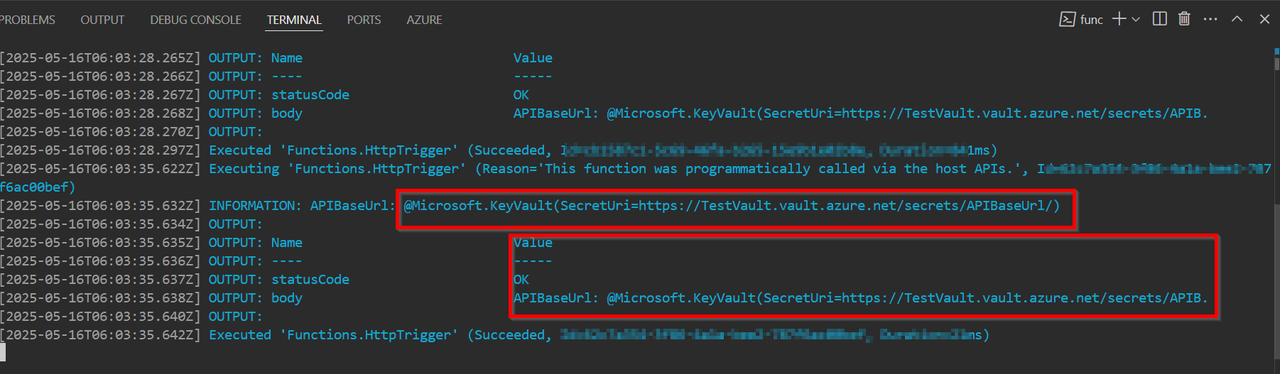
Key Vault references using the @Microsoft.KeyVault(...) syntax do not work locally when using Azure Functions and local.settings.json. This syntax only works in Azure, where the App Service platform resolves it using the Function App's Managed Identity.
Repro Fails Locally by using @Microsoft.KeyVault(...) key vault reference.
{
"IsEncrypted": false,
"Values": {
"APIBaseUrl": "@Microsoft.KeyVault(SecretUri=https://TestVault.vault.azure.net/secrets/APIBaseUrl/)"
}
}
When I run func start locally, the value of APIBaseUrl not resolved. It was treated as a literal string.
enter image description here This only works in Azure app service, Function app where we configure a system-assigned managed identity and granted it to the key vault.
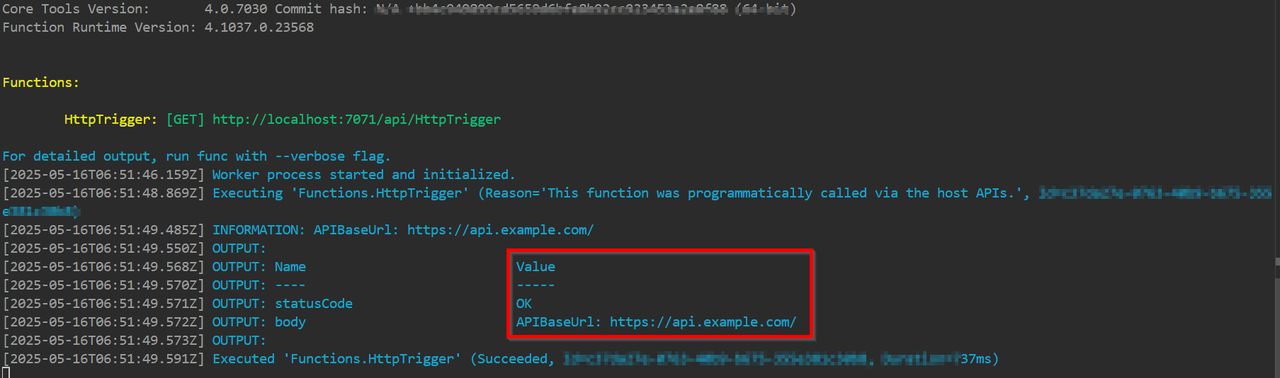
We can fix this by putting the actual secret values directly in local.settings.json while working locally. Since the Key Vault references don’t work outside Azure, hardcoding the secrets is the easiest way to make things run smoothly during development.
Replace the Key Vault reference in local.settings.json with the actual secret value for local testing:
{
"IsEncrypted": false,
"Values": {
"APIBaseUrl": "https://api.example.com/"
}
}
enter image description here Then, function will output the real secret locally. Note: - Make sure this file is never committed to git, as it may contain sensitive information like secrets and connection strings.
Please refer to the provided Microsoft Doc1, Doc2 for reference.
1.Check if the key is loaded:
console.log(process.env.OPENAI_API_KEY);
If it's undefined, dotenv didn't load it correctly.
2.Check if your network block access to external APIs by using curl.
curl https://api.openai.com/v1/models -H "Authorization: Bearer your-api-key"
If this fails, it's a network issue, not your code.
Please provide the complete error message and your config to analyze the problem.
Whilst @m-Elghamry didn't actually solve my problem, he did force me to relook at the issue and it turns out there was a separate field that also needed to be initialized that was actually causing the issue. The compiler was just sending me on a wild goose chase after the wrong property.
Essentially the issue was that the record required 11 constructor arguments and the mapping only catered for 9 of them. So I had to use the [MapValue(...)] attribute on the missing fields and map then to a function call to supply the appropriate value, case closed.
Are you looking for a powerful, secure, and scalable solution to run QuickBooks Enterprise seamlessly? OneUp Networks’ QuickBooks Enterprise Hosting brings cloud flexibility to your high-performance accounting software, ensuring remote access, enhanced security, and top-tier speed.
Whether you’re a growing business, accounting firm, or enterprise, our hosting solutions empower your team to work from anywhere while keeping your financial data safe and accessible.
✅ Remote Access from Any Device
Run QuickBooks Enterprise from your PC, Mac, tablet, or smartphone, enabling your team to work from anywhere, anytime!
✅ Superior Multi-User Collaboration
Grant access to multiple users simultaneously, ensuring seamless collaboration with your team, accountants, and clients.
✅ High-Performance Cloud Servers
Our hosting guarantees lightning-fast speeds, 99.99% uptime, and uninterrupted access, so you never face downtime.
✅ Bank-Level Security & Data Protection
We offer end-to-end encryption, automatic backups, and 24/7 monitoring to keep your financial data safe from cyber threats and data loss.
✅ Scalability for Growing Businesses
Quickly scale your hosting resources to match your business growth without worrying about infrastructure limitations.
✅ Seamless Integrations with Third-Party Apps
Easily integrate QuickBooks Enterprise with payroll, CRM, tax software, and over 200+ add-ons to streamline your accounting operations.
📌 Medium & Large Businesses – Enjoy enterprise-level accounting with the flexibility of cloud access.
📌 Accounting Firms & CPAs – Manage multiple clients efficiently with multi-user, remote access.
📌 Retailers, Manufacturers & Contractors – Utilize industry-specific features while ensuring real-time data accessibility.
📌 Remote & Hybrid Teams – Keep employees connected with secure, cloud-based collaboration tools.
💡 Upgrade to Smarter Accounting with OneUp Networks!
With QuickBooks Enterprise Hosting, your business gains the power, security, and flexibility needed to streamline accounting processes and maximize efficiency.
📢 Get started today! Learn more: OneUp Networks
#OneUpNetworks #QuickBooksEnterprise #QuickBooksHosting #CloudAccounting #BusinessGrowth #CPAs #SecureFinance #RemoteWork #EnterpriseSolutions
I have found a pattern and it is that if I use a page with a webview in which the microphone is used upon exiting, I get a bug and it forces me to restart the phone. Any help? If I restart the phone it works without a problem?
if you are following the normal jitsi setup without docker then follow this on jibri server
Update /etc/hosts file
/etc/hosts file with hostname as jvb
update /etc/jitsi/jibri/config.json file
/etc/jitsi/jibri/config.json uipdate this file with ipaddres or domain name of JVB
xmpp connects with the jvb from jibri.
reboot the server to apply /etc/hosts file
https://dev.azure.com/your_org/_pulls
Follow that link or click on "Show more" in the PR bucket list. It takes you to the active PRs. There select on the top right:
Customize View -> Add section
In the menu select Status: All. The newly added section contains also the completed PRs.
we can use the pipe (|) now like
$date = DateTime::createFromFormat('Y-m-d|', '2025-05-14');
File upload done.
Updating service [default]...failed.
ERROR: (gcloud.app.deploy) Error Response: [13] Failed to create cloud build: API key expired. Please renew the API key..
Same here....
What the hell is going on!!!??? I deployed yesterday without any issues!!!
https://stackoverflow.com/questions/79604979/condensing-a-query-into-a-single-better-formatted-query
Updated Query
==========
SELECT
students.DriverLicense,
SUM(CASE WHEN students.QuizTitle LIKE 'THEORY%' THEN students.Earned ELSE 0 END) AS Theory,
SUM(CASE WHEN students.QuizTitle LIKE 'HAZMAT%' THEN students.Earned ELSE 0 END) AS Hazmat,
SUM(CASE WHEN students.QuizTitle LIKE 'PASS%' THEN students.Earned ELSE 0 END) AS Pass,
SUM(CASE WHEN students.QuizTitle LIKE 'SCHOOL%' THEN students.Earned ELSE 0 END) AS Bus
FROM students
WHERE students.DriverLicense = 'D120001102'
GROUP BY students.DriverLicense;
This query will do the following
1.It sums Earned only for matching QuizTitle values using CASE.
2.All results are returned in one row, grouped by DriverLicense.
3.It avoids using multiple subqueries or UNION.
https://www.pqube.us/
I used MX3232 and connected to CH340 becuase RS232 signaling is different than ch340 and it doesn't work if you directly try to connect rs232 to ch340.
Update: the issue was fixed in docker.io/bitnami/airflow:3.0.1-debian-12-r1.
Same here, getting the same error today
Same here! with Cloud Build for an App Engine deploy...
I created a header file called python, allowing to use input and print like in python but in the C++ language, following the same problem as you that I have not managed to solve. I will give you the link to the github I just posted it quickly not long ago
Same issue here too. Only noticed an hour or two ago
Same here. GAE deployment failed.
Seem CloudRun..etc no pbm
Same issue with Google App Engine (Cloud Run is looking good).
In my case this issue was solved by defining user and group in www.conf
[www]
user = www-data
group = www-data
...
Just found the easy solution, it is to actually do set the quarkus.datasource.username:
quarkus.flyway.migrate-at-start=true
quarkus.flyway.schemas=oracletest
quarkus.datasource.username=oracletest
That may be obvious when comparing it with a production environment where schema name and user name are the same. In my case of an integration test environment based on devservices it took me some time to find out.
Experiencing the same issue while using gcloud app deploy with no solution so far
I got the same problem just now, could be an error on their end.
I’m getting the same error too—in my case it happens when I try to deploy to App Engine through Cloud Build.